
The Namma Metro is transforming Bengaluru, but not every property along its route comes with unlimited development rights.
For most buyers, proximity to a Metro station is considered a major advantage. Better connectivity often translates into higher property values, stronger rental demand and improved quality of life.
However, there is one aspect of metro infrastructure that many buyers, investors and even landowners are unaware of—the restrictions applicable to properties located within the influence zone of underground metro tunnels and stations.
As Bengaluru’s underground metro network expands through areas such as MG Road, Vellara Junction, Shivajinagar, Cantonment, Dairy Circle, Nagawara and other upcoming corridors, understanding these regulations has become more important than ever.
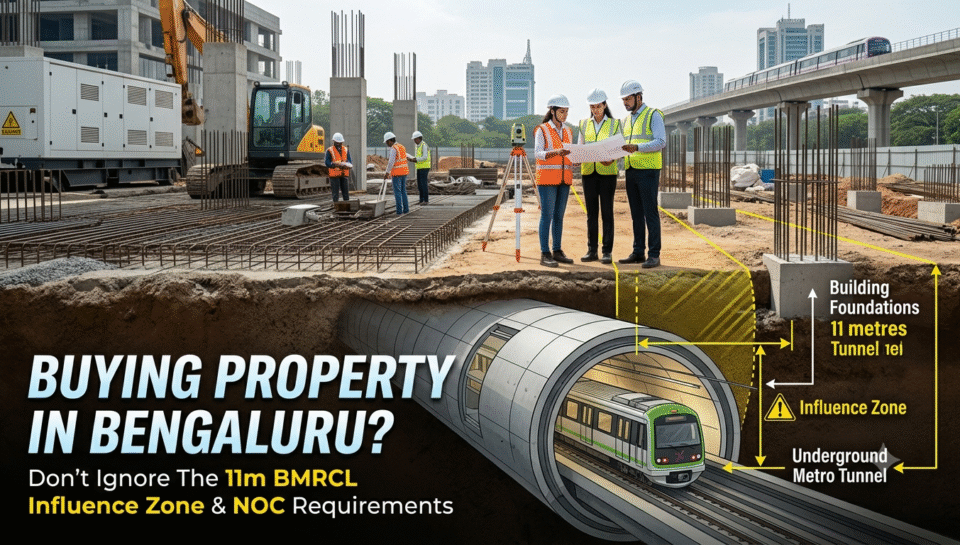
In 2020, the Karnataka Government notified an “Influence Zone” around underground metro structures to safeguard the structural integrity of tunnels, stations and ramps. Within this zone, property owners cannot freely undertake construction, demolition, deep excavation or borewell drilling without obtaining approval from the Bangalore Metro Rail Corporation Limited (BMRCL). The notification defines the influence zone as 11 meters from the outer edge of underground metro structures on either side, and approvals from agencies such as BBMP and BDA require a BMRCL No Objection Certificate (NOC) wherever applicable.
Owning land within the influence zone does not mean you lose ownership of your property.
However, if you intend to:
- Construct a new building
- Add additional floors
- Undertake deep basement excavation
- Drill borewells
- Redevelop an old structure
- Carry out major structural modifications
You may first need technical scrutiny and approval from BMRCL before obtaining statutory sanctions.
Depending on the location and engineering assessment, developers may also need specialized foundation designs or construction methodologies.
Imagine purchasing a prime commercial site with plans for a three-level basement and a high-rise office tower.
Only during the planning stage do you discover that an underground metro tunnel passes beneath or adjacent to the property. The project may still be feasible—but the approval process could become more complex, the construction methodology may change, and costs could increase.
These are factors that directly affect project feasibility and investment returns.
This is not an argument against buying properties near the Metro. The issue is not proximity to the Metro—it is understanding whether the property falls within the notified influence zone of an underground corridor and what that means for future development.
An informed investor can enjoy the benefits of connectivity while avoiding unpleasant surprises during construction. Before purchasing land or redevelopment properties in Bengaluru, buyers should ask:
- Is there an existing or proposed underground metro corridor beneath or adjoining the property?
- Does the property fall within the notified BMRCL influence zone?
- Will future construction require a BMRCL NOC?
- Are there any restrictions on excavation, basements or structural design?
- Has the seller disclosed these aspects?
These questions are just as important as checking title deeds, Khata, zoning and RERA compliance.
The CredNxt Perspective
At CredNxt Consulting, we believe that informed real estate decisions go beyond location and price.
Every property should be evaluated for its legal status, planning regulations, infrastructure impact and future development potential. A thorough due diligence process today can prevent costly surprises tomorrow.
As Bengaluru continues to build one of India’s largest metro networks, buyers must recognize that good infrastructure adds value—but understanding the regulations around that infrastructure protects your investment.

With over 30 years of industry expertise, Sadiq is an execution-focused leader with a distinguished track record across global financial institutions and the real estate sector.
As Strategic Director – Real Estate, he brings deep expertise in business development, strategic partnerships, and investment-led growth. Known for his execution excellence and market insight, he has consistently delivered high-value solutions across the real estate and private equity sectors.